Newsletter
What to weigh up when the old boiler needs replacing
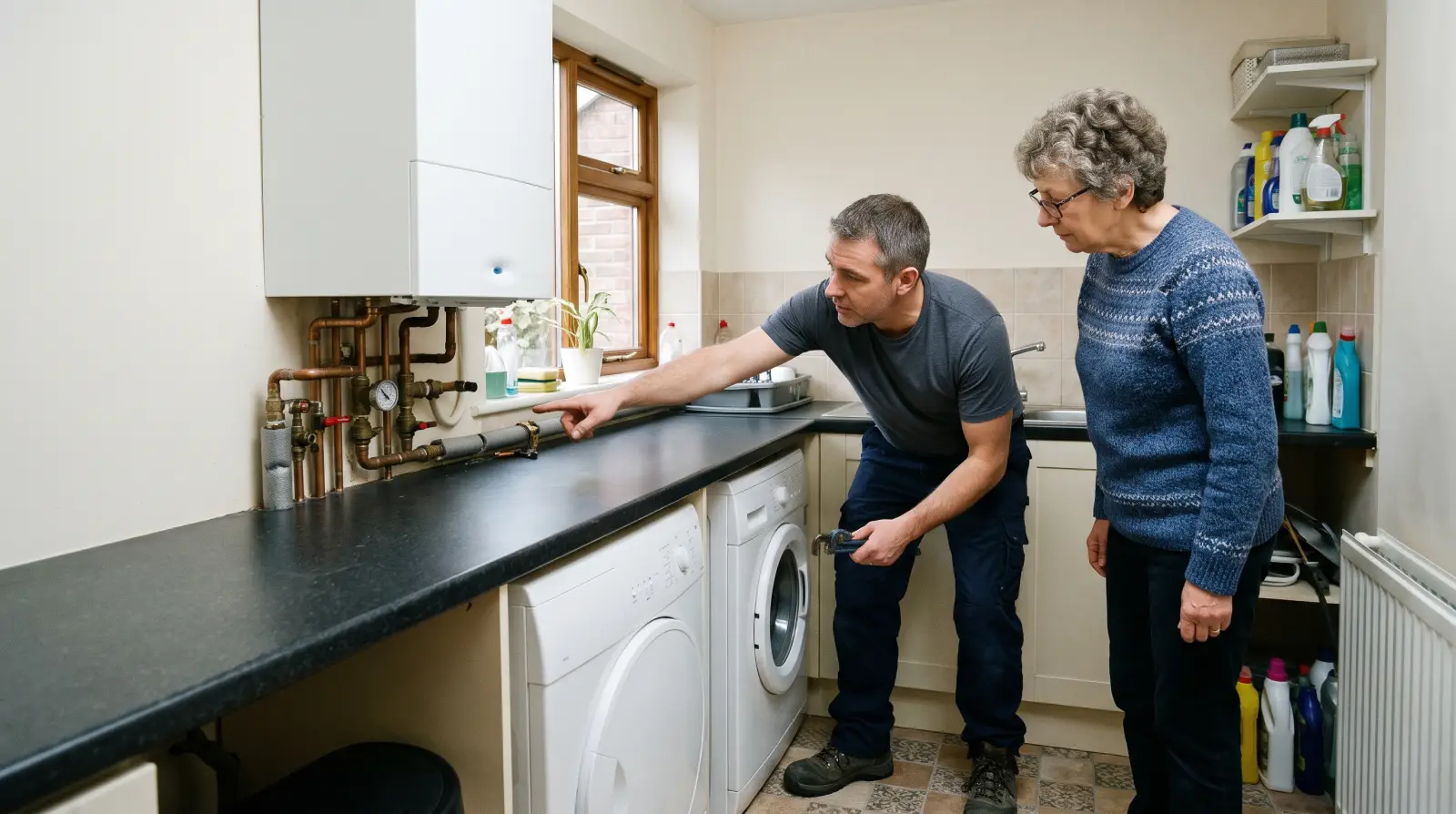
Most boilers are replaced in a hurry, after a breakdown in the first cold week of the year. Knowing the options and the rules beforehand makes that conversation with an installer a lot calmer.
An ageing boiler usually gives some warning: a pressure gauge that keeps dropping, or an engineer who mentions that parts are getting hard to find. That warning leaves time to compare more than one kind of quote.
For most households in England and Wales the choice is a like-for-like gas boiler or a heat pump, with a government grant towards the second. Neither suits every home.
Two routes, one decision
A new gas boiler is the familiar route. It usually fits where the old one was, uses the existing radiators and is often installed in a day or two.
A heat pump moves heat from the outside air or the ground indoors using electricity. It works best in a home that holds its heat, and may need larger radiators, a hot water cylinder and space outside. The upfront price is usually higher, which is what the Boiler Upgrade Scheme is meant to offset.
Our guide to what the letter on an Energy Performance Certificate tells you explains how a home’s energy performance is rated.
The rules for a new gas boiler
Anyone who works on a gas appliance in a home must be on the Gas Safe Register. Each engineer carries an ID card, and the back of the card lists the types of work they are qualified to do. The Health and Safety Executive points householders to the register, which can also be checked by phone on 0800 408 5500.
A replacement boiler counts as building work under the Building Regulations. A Gas Safe registered installer can self-certify the job, which means they deal with the notification for you. You should receive a commissioning record, often called the Benchmark checklist, filled in by the installer, and afterwards a certificate confirming that the work complies with the Building Regulations. If the work is not done by a registered installer, the homeowner has to notify the council and pay a fee.
In England, the Boiler Plus standard has applied since April 2018. A new gas boiler must have an efficiency of at least 92% under the ErP rating, and must be fitted with a timer and a room thermostat. A new combination boiler also needs one extra energy-saving measure from a short list: flue gas heat recovery, weather compensation, load compensation or smart controls.
Once it is in, the Health and Safety Executive strongly advises a service at least once a year by a Gas Safe registered engineer.
How the Boiler Upgrade Scheme works
The Boiler Upgrade Scheme is run by Ofgem for the government. It does not pay money to the householder. Instead, the installer applies for a voucher and takes the grant off the price, so it appears as a discount on the quote and invoice. The installer must be certified under the Microcertification Scheme (MCS), and since 28 April 2026 the grant has to be given as an upfront discount.
The grant levels published on GOV.UK are:
- £7,500 towards an air source heat pump (air-to-water) or a ground source heat pump, including water source and shared ground loops;
- £5,000 towards a biomass boiler, for rural homes off the gas grid only;
- £2,500 towards an air-to-air heat pump, for homes only, eligible since 28 April 2026.
Ofgem also lists an extra £1,500 for homes heated by oil or LPG that have no mains gas connection, taking the heat pump grant to £9,000 in those cases. Ofgem states that this higher amount is available until 31 March 2027. The scheme itself has been extended to 2030.
The grant never reaches your bank account. It is a line on the installer’s invoice.
Who the scheme covers
According to GOV.UK, the scheme is open to properties in England and Wales where:
- you own the property, whether you live there, let it out or use it as a second home;
- the new system replaces fossil fuel heating, such as gas, oil, LPG or direct electric heating;
- the installation is completed within 120 days of the application.
Social housing is excluded, and so are new homes that a developer is still building.
One change is worth knowing about. From 28 April 2026 an Energy Performance Certificate is no longer a condition of the grant. If the home has one, the installer still records its certificate number on the application.
How the grant shows on a quote
Installed prices for heat pumps vary widely with the size of the home, the radiators needed and the work involved, so the figures below are invented. They only show where the grant sits.
| Line on the quote | Home on mains gas | Home heated by oil |
|---|---|---|
| Installed price before the grant | £13,000.00 | £13,000.00 |
| Boiler Upgrade Scheme discount | −£7,500.00 | −£9,000.00 |
| Paid by the homeowner | £5,500.00 | £4,000.00 |
Assumes both homes are in England or Wales and eligible, and that the oil-heated home has no mains gas and is installed by 31 March 2027. Real prices vary.
Worth checking: on any heat pump quote, look for the grant shown as a separate discount line, the installer’s MCS certification number, and whether larger radiators or a hot water cylinder are included in the price or quoted as extras.
Scotland and Northern Ireland
The Boiler Upgrade Scheme does not cover Scotland or Northern Ireland.
In Scotland, support comes through Home Energy Scotland. Its heat pump funding is a grant of up to £7,500, with an optional interest-free loan of up to £7,500 on top, and an extra £1,500 for rural and island homes. Air-to-air, hybrid and exhaust-air heat pumps are not eligible, the installer must be MCS certified, and a written offer has to be in place before any work starts.
In Northern Ireland, the Boiler Replacement Scheme is closed, according to GOV.UK.
Who this matters for, and what to check
This is most relevant to homeowners whose boiler is near the end of its life. Points to check:
- the installer’s Gas Safe registration and the work listed on their card, for a gas boiler;
- the installer’s MCS certification, for a heat pump, and that they will make the grant application;
- which nation’s scheme applies to your home;
- whether your home is off the gas grid and heated by oil or LPG, which affects the grant level until 31 March 2027;
- how and when the deposit is to be paid. Our article on the name check banks run on payments explains what to look for when paying a tradesperson by bank transfer.
Buying a home with an old boiler? A survey can flag it first; see our guide to the three levels of RICS home survey.
The short version
A new gas boiler in England must reach 92% efficiency and be fitted by a Gas Safe registered engineer, who also handles the Building Regulations paperwork. An eligible heat pump in England or Wales can attract a Boiler Upgrade Scheme grant of £7,500, or £9,000 for oil and LPG homes off the gas grid until 31 March 2027, taken off the installer’s price. The scheme no longer requires an EPC and runs to 2030. Scotland has its own grant and loan; Northern Ireland is not covered.
Official sources
- GOV.UK: Apply for the Boiler Upgrade Scheme, what you can getGrant levels by technology
- Ofgem: Boiler Upgrade SchemeInstaller applies; £1,500 off-gas-grid uplift until 31 March 2027
- Health and Safety Executive: gas safety, frequently asked questionsGas Safe registration, ID card, annual service
- Home Energy Scotland: heat pump grants and fundingGrant and interest-free loan in Scotland
 03 / Home
 04 / Money safety